
The ongoing Iran–US–Israel War (2026) has emerged as one of the most significant geopolitical crises of the 21st century. Triggered by direct military strikes between the United States, Israel, and Iran, the conflict has rapidly expanded across the Middle East, affecting global energy markets, regional stability, and international diplomacy.
With over 5,000 casualties across 14+ countries, the conflict has evolved into a multi-theatre war, involving state and non-state actors, including proxy groups like Hezbollah and Houthis.
Background of Iran US Israel War 2026
Long-standing tensions over:
- Iran’s nuclear program
- Israel’s security concerns
- US sanctions and strategic dominance
Breakdown of diplomatic frameworks like the Iran Nuclear Deal (JCPOA) Escalation through proxy wars in:
- Syria
- Iraq
- Lebanon
Causes of Iran–US–Israel War 2026
1. Nuclear Tensions
- The Iran nuclear program remained the central flashpoint
- Concerns:
- Uranium enrichment beyond permissible limits
- Weak monitoring after breakdown of nuclear agreements
- The United States and Israel feared:
- Iran achieving nuclear weapon capability (threshold state)
2. Israel’s Security Concerns
- Israel perceives Iran as an existential threat
- Key factors:
- Iran’s support to Hezbollah and other proxy groups
- Frequent missile and drone threats
- Anti-Israel rhetoric by Iranian leadership
3. US Strategic Interests
- The United States aims to:
- Maintain hegemony in West Asia
- Protect allies (especially Israel & Gulf states)
- Ensure energy security (oil flow via Strait of Hormuz)
- Additional goals:
- Contain Iran’s regional influence
- Prevent emergence of anti-US power bloc
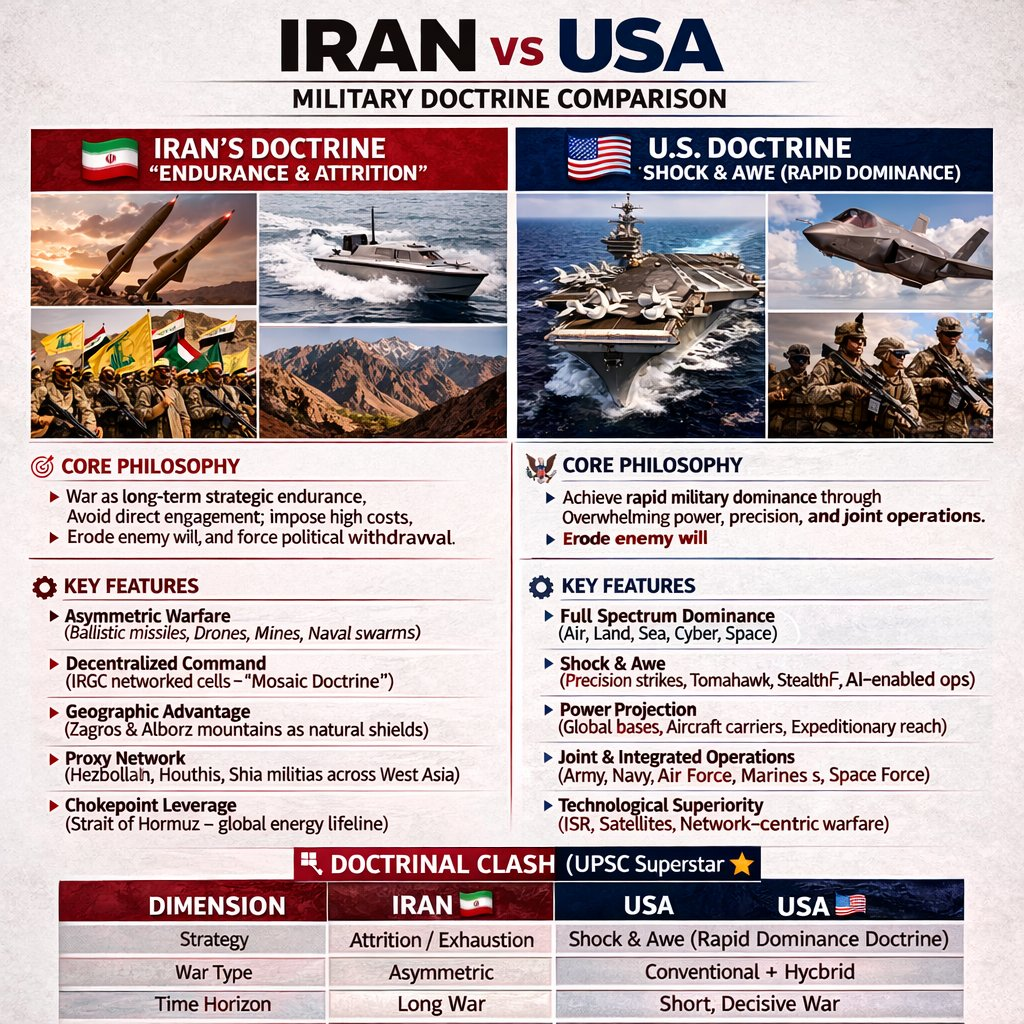
Timeline of Events (2026 War)
| Phase | Time Period | Key Events | Major Actors Involved | Significance (UPSC Angle) |
|---|---|---|---|---|
| Phase 1: Initial Strikes | Feb 28, 2026 | – United States & Israel launched coordinated airstrikes on Iran – Iran retaliated with missile & drone attacks on Israel and US bases in Gulf countries | USA, Israel, Iran | – Formal beginning of war – Shift from proxy conflict → direct state confrontation – Massive initial strikes (hundreds of targets hit) |
| Phase 2: Regional Escalation | Early March 2026 | Lebanon Front: – Hezbollah attacked Israel – Israel retaliated with heavy bombardment Iraq & Gulf Region: – Drone & missile attacks intensified across region Key Incident: – US strike on Iranian warship near Sri Lanka (100+ killed) | Hezbollah, Israel, Iran, USA | – War expands beyond bilateral conflict – Emergence of proxy warfare – Multi-front conflict begins |
| Phase 3: Expansion Across Regions | Mid–Late March 2026 | – War spread to multiple countries: • Oman (neutral mediator hit) • UAE, Saudi Arabia, Kuwait – Attacks on: • Oil infrastructure • Airports • Military bases | Iran, USA, Israel, Gulf countries | – Threat to global energy security – Strategic chokepoints (like Strait of Hormuz) under risk – Conflict becomes global geopolitical crisis |
Recent Developments (March 2026)
- Houthis entered war, launching missiles toward Israel
- US deployed thousands of Marines in the Middle East
- Pentagon planning limited ground operations (not full invasion)
- Iran threatened retaliation against US-linked universities in the region
Key Features of the Conflict
1. Multi-Country Involvement
- Conflict spans:
- Iran
- Israel
- Iraq
- Lebanon
- Gulf countries
- Death toll across 14+ countries
2. Proxy Warfare
- Iran-backed groups:
- Hezbollah (Lebanon)
- Houthis (Yemen)
- Use of:
- Drones
- Ballistic missiles
3. Hybrid Warfare
- Combination of:
- Air strikes
- Cyber threats
- Drone warfare
- Economic disruptions
4. Energy Infrastructure Targeting
- Oil routes and refineries targeted
- Strait of Hormuz under threat
- Global supply chain disruption
Global Impact of the War
1. Energy Security Crisis
- Middle East handles ~20% of global oil supply
- Rising crude oil prices
- Increased shipping costs
2. Economic Impact
- Inflation pressures globally
- Disruption in trade routes
- Increased insurance costs for shipping
3. Humanitarian Crisis
- Thousands killed (including civilians and children)
- Infrastructure damage:
- Universities
- Power plants
- Water facilities
4. Risk of Nuclear Escalation
- Strikes near nuclear facilities like Bushehr
- Iran considering withdrawal from NPT (Non-Proliferation Treaty)
Impact on India (UPSC Important)
1. Energy Security
- India imports ~85% of crude oil
- Rising prices → inflation risk
2. Economic Growth
- Government flagged downside risk to GDP growth (7–7.4%)
- Supply chain disruptions
3. Indian Diaspora
- Large Indian population in Gulf countries
- Risk of evacuation scenarios
4. Strategic Diplomacy
- India maintaining:
- Neutral stance
- Dialogue with both Iran & US
- PM Narendra Modi engaged with Gulf leaders
5. Maritime Security
- Threat to:
- Strait of Hormuz
- Red Sea routes
- Impact on Indian trade
Role of Major Global Powers
United States
- Leading military operations
- Considering ground raids
- Strategic objective: weaken Iran
Israel
- Targeting Iranian nuclear and military infrastructure
- Facing missile retaliation
Iran
- Retaliatory strikes across region
- Using proxy networks
- Warning of “heavy price”
Russia & China (Indirect Role)
- Monitoring situation
- Potential diplomatic interventions
Way Forward
1. Diplomatic Negotiations
- Oman mediating US–Iran talks
- Need for ceasefire
2. De-escalation Mechanisms
- Avoid targeting civilian infrastructure
- Confidence-building measures
3. Global Cooperation
- UN intervention
- Multilateral diplomacy
4. Energy Diversification (For India)
- Renewable energy push
- Strategic petroleum reserves
Conclusion
The Iran–US–Israel War 2026 represents a critical turning point in global geopolitics. It highlights the fragility of Middle Eastern stability and its direct implications for global energy markets, international security, and India’s strategic interests.
Iran–US–Israel War 2026: FAQs
1. What is the Iran–US–Israel War 2026?
A conflict that began on 28 Feb 2026 after United States and Israel attacked Iran, triggering regional escalation.
2. What are the main causes of the war?
Nuclear tensions, Israel’s security concerns, and US strategic interests.
3. Who are the main parties involved in the conflict?
Primary: US, Israel, Iran; Secondary: Hezbollah, Houthis.
4. When did the war officially start?
On 28 February 2026 with coordinated airstrikes on Iran.
5. Why is the Strait of Hormuz important in this conflict?
It carries ~20% of global oil, so disruption affects global energy supply.
6. What type of warfare is being used?
Hybrid warfare—missiles, drones, cyber attacks, and proxy forces.
7. How has the conflict expanded geographically?
From Iran–Israel to Lebanon, Iraq, and Gulf countries.
8. What is the role of proxy groups in the war?
They expand the conflict by attacking Israeli and US-linked targets.
9. What are the global impacts of this war?
Energy crisis, inflation, disrupted trade, and geopolitical instability.
10. How does the war impact India?
Higher oil prices, trade risks, diaspora concerns, and strategic balancing.
11. Is there a risk of nuclear escalation?
Yes, due to attacks on nuclear sites and rising tensions.
12. Why is this conflict important for UPSC preparation?
It covers IR, energy security, geopolitics, and current affairs.